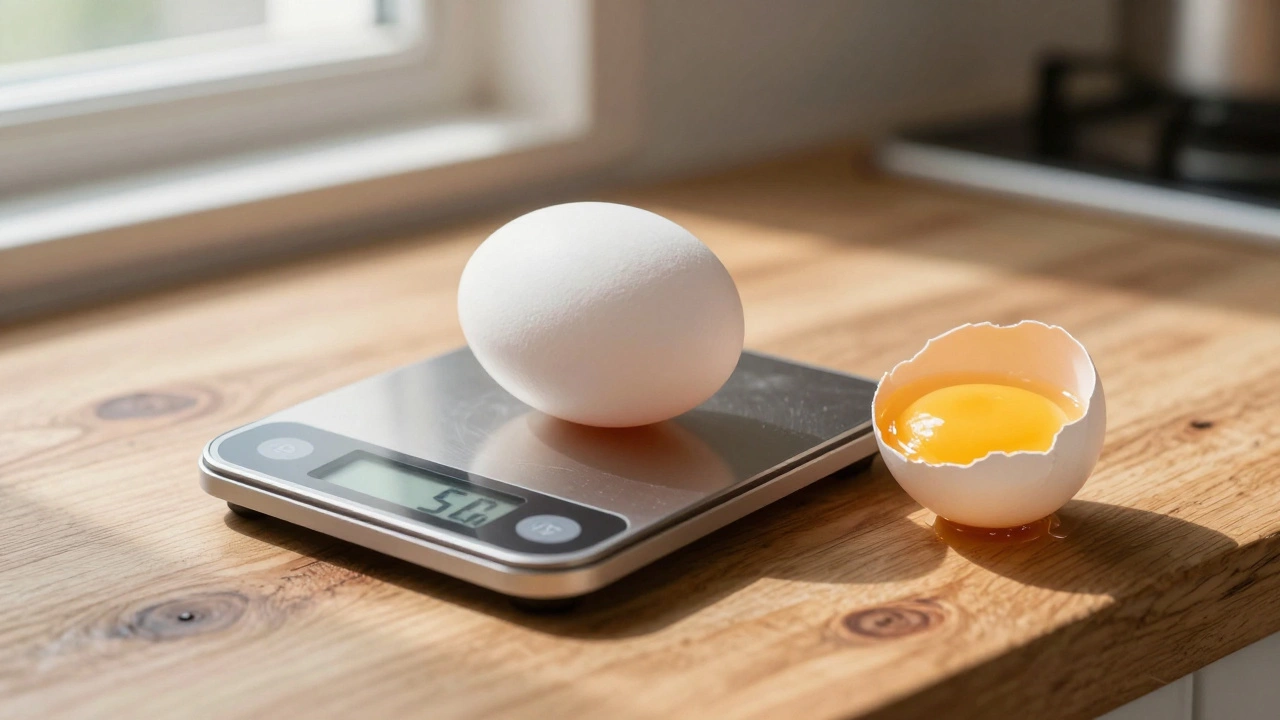
Egg Calorie & Macro Calculator
It sounds like a simple question, but the answer depends entirely on where you buy your eggs. If you are standing in the kitchen holding a carton of standard large chicken eggs, you are looking at roughly 72 calories. But if you grab a small one or a jumbo one, that number shifts significantly. This matters more than you might think, especially if you are tracking macros or trying to perfect a delicate dessert like tiramisuan Italian coffee-flavored dessert made with mascarpone, eggs, sugar, and ladyfingers.
The Calorie Breakdown by Size
Most grocery stores sell eggs in standardized sizes, but those sizes vary by weight. The USDA (United States Department of Agriculture) provides the gold standard for these numbers. Here is what you actually get when you crack open an egg of different sizes:
| Egg Size | Weight (approx.) | Total Calories | Protein (g) | Fat (g) |
|---|---|---|---|---|
| Small | 38g | 54 kcal | 3.6g | 3.5g |
| Medium | 44g | 63 kcal | 4.2g | 4.1g |
| Large (Standard) | 50g | 72 kcal | 6.3g | 4.8g |
| Extra Large | 56g | 80 kcal | 7.0g | 5.3g |
| Jumbo | 63g | 90 kcal | 7.9g | 6.0g |
Notice how the protein jumps from 3.6 grams in a small egg to nearly 8 grams in a jumbo. That is a massive difference if you are counting protein for muscle recovery. For most recipes, including classic tiramisu, "large" is the default assumption unless stated otherwise.
Yolk vs. White: Where Do the Calories Hide?
If you are watching your fat intake, you probably separate your eggs. It is a common myth that the white contains almost no calories. It does have some, but the real energy density lives in the yolk.
A single large egg white has about 17 calories and consists mostly of water and protein. It is lean, clean fuel. The yolk, however, packs the remaining 55 calories. That yolk contains all the fat, cholesterol, vitamins A, D, E, and K, and choline.
Why does this matter for baking? In desserts like tiramisu, the yolk provides richness and structure through emulsification. The white provides volume when whipped. If you swap whole eggs for just whites, you lose the creamy texture and the distinct flavor profile. You also change the calorie count drastically. Using three whole eggs adds 216 calories; using three whites adds only 51. That changes the entire nutritional landscape of your dish.

Does Cooking Change the Calorie Count?
Here is a trick question: Does frying an egg add calories? The egg itself stays the same. A boiled, poached, or steamed large egg remains at 72 calories. However, the moment you introduce oil, butter, or bacon grease, the calorie count skyrockets.
- Poached/Boiled: 72 calories (no added fat).
- Scrambled with 1 tsp butter: ~100 calories (butter adds ~35 calories).
- Fried in oil: ~90-100 calories depending on absorption.
- Omelet with cheese: Adds another 50-100 calories easily.
For baking, we usually cook eggs by heating them within the batter or cream. No extra fat is added during the mixing phase, so the base calorie count of the raw egg applies directly to your final product.
Eggs in Tiramisu: The Structural Hero
You mentioned tiramisu, which is interesting because traditional Italian tiramisu relies heavily on eggs. Specifically, it uses a zabaglione-style mixture of egg yolks and sugar, whipped until pale and thick. Some modern variations use pasteurized eggs or skip the raw aspect entirely due to safety concerns, but the classic method uses raw or lightly cooked yolks.
In a standard recipe serving 8 people, you might use 4 to 6 egg yolks. Let’s do the math:
- 4 large yolks = 220 calories total from eggs alone.
- That averages to 27.5 calories per serving from the egg component.
This seems low compared to the mascarpone cheese (which is high in fat) and the ladyfingers soaked in coffee and liqueur. However, the eggs provide the structural integrity that keeps the mousse light rather than dense. Without them, you would need to substitute with heavy cream or gelatin, which alters both the texture and the calorie density.

Nutritional Density Beyond Calories
Focusing solely on calories misses the point of why eggs are considered a superfood. One large egg provides:
- Choline: Essential for brain health and cell membrane structure. Most adults don’t get enough.
- Lutein and Zeaxanthin: Antioxidants that protect eye health.
- Selenium: Supports thyroid function and antioxidant defense.
- Vitamin B12: Critical for nerve tissue health and brain function.
When you eat an egg, you are getting highly bioavailable nutrients. Plant-based sources often require larger portions to match this nutrient density, which can mean higher overall calorie intake for the same nutritional benefit.
Common Questions About Egg Calories
Do organic or free-range eggs have fewer calories?
No. The farming method affects the taste and ethical considerations, but not the macronutrient profile significantly. A large free-range egg still has approximately 72 calories. The omega-3 content might be slightly higher in pasture-raised eggs, but the calorie difference is negligible.
Can I use egg substitutes in baking without changing the calories?
Commercial liquid egg substitutes are often just egg whites with added vitamins. They have fewer calories (about 15-20 per tablespoon equivalent) but lack the fat needed for richness. In a recipe like tiramisu, substituting whole eggs with whites will result in a less creamy, lighter texture. You may need to adjust sugar or fat elsewhere to compensate.
Is it safe to eat raw eggs in tiramisu?
There is a small risk of Salmonella. To mitigate this, many bakers use pasteurized eggs, which are heat-treated to kill bacteria while remaining liquid. Alternatively, you can gently cook the egg yolk and sugar mixture over a double boiler until it reaches 160°F (71°C), creating a safe zabaglione without compromising texture.
How many calories are in an egg white only omelet?
An omelet made with three large egg whites contains approximately 51 calories before cooking. If you cook it in a non-stick pan with minimal spray oil, the total remains under 60 calories. This makes it a popular choice for low-calorie breakfasts.
Do duck eggs have more calories than chicken eggs?
Yes. Duck eggs are larger and richer. A typical duck egg weighs about 70-80 grams and contains around 130-150 calories. They have a higher fat content and a richer flavor, making them excellent for baking but denser in calories.