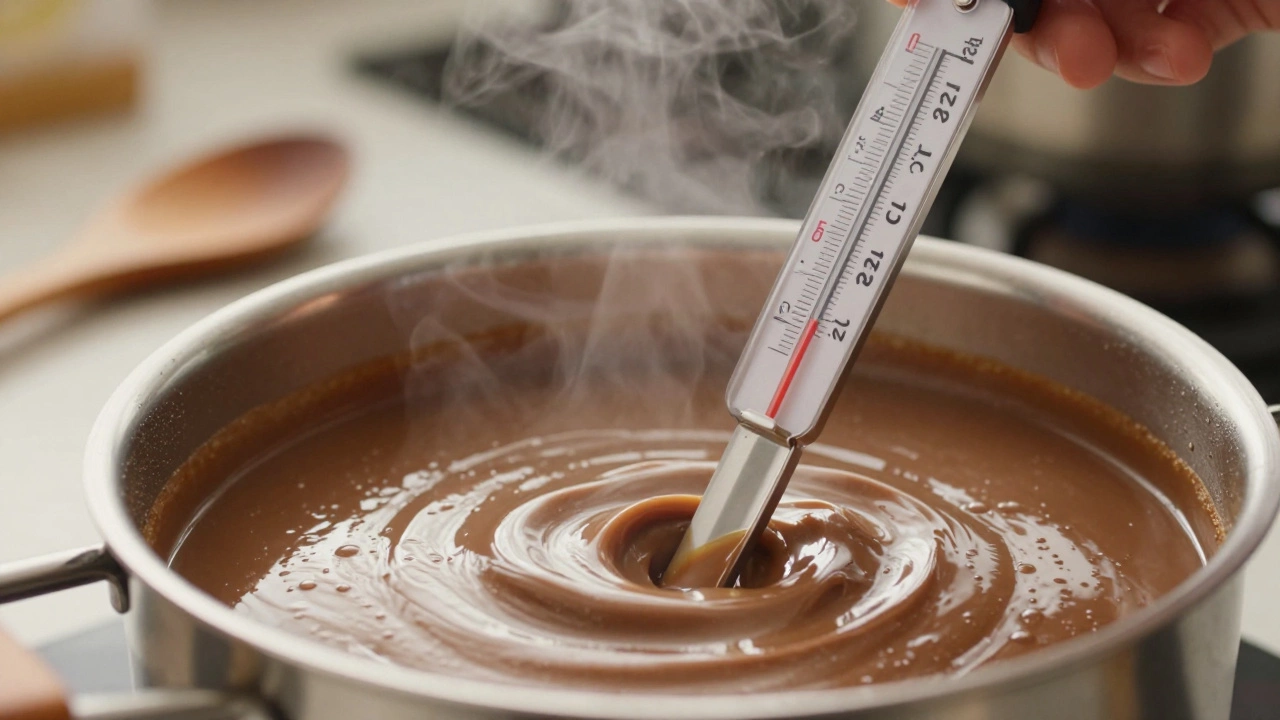
Fudge Cooling Calculator
Cooling Guide
Perfect fudge needs to cool to 49°C (120°F) before stirring. Stirring too early causes large sugar crystals that make fudge grainy.
Ideal stirring temperature: 49°C
Ever made fudge that turned out grainy, hard, or just plain weird? You followed the recipe to the letter-measured the sugar, boiled the mixture, even used a candy thermometer-but something still went wrong. More often than not, the culprit isn’t the ingredients. It’s what you did after the pot came off the stove. Stirring fudge too early is one of the most common mistakes home bakers make, and it ruins the texture every time.
Why Fudge Needs to Cool Before Stirring
Fudge isn’t just sweetened milk and chocolate. It’s a delicate sugar crystal structure. When you heat sugar, water, and cream together, you’re making a supersaturated solution. That means you’ve dissolved way more sugar than water normally can hold at room temperature. As the mixture cools, those sugar molecules want to come out of solution and form crystals. The goal? Tiny, uniform crystals that give fudge its smooth, melt-in-your-mouth texture.But if you stir the mixture while it’s still hot-say, right after you take it off the heat-you’re giving those sugar molecules a nudge to start crystallizing too soon. Instead of forming hundreds of tiny crystals, they clump together into a few large ones. That’s what makes fudge grainy. Think of it like sand versus powdered sugar. Grainy fudge feels like sand in your mouth. Smooth fudge? It’s like velvet.
What Temperature Should Fudge Reach Before Stirring?
The magic number is 112°C (234°F). That’s the soft-ball stage. When your fudge mixture hits this temperature, the water content has reduced enough to form the right syrup consistency. But here’s the catch: you don’t stir at 112°C. You take it off the heat at 112°C and let it cool unstirred to about 49°C (120°F).Why wait? Because cooling without disturbance lets the sugar molecules stay dissolved longer. As the mixture drops below 50°C, the viscosity increases, and the sugar molecules start to form nuclei-tiny starting points for crystals. At this point, stirring gently helps distribute those nuclei evenly. That’s when you get hundreds of microscopic crystals. Stir too early, and you get a handful of giant ones.
What Happens If You Stir Too Early?
If you stir while the mixture is still above 60°C (140°F), you’ll likely see one or more of these results:- Grainy texture - The most common outcome. You’ll taste little grits instead of silk.
- Too hard or crumbly - Over-crystallization makes the fudge brittle, not chewy.
- Separation - Fat and sugar split. The fudge looks oily or greasy on top.
- Won’t set at all - If you stirred so early that crystallization never properly started, the fudge stays runny.
One baker I know made fudge for a holiday gift and stirred it as soon as the pot came off the stove. She thought she was being efficient. The result? A sticky, grainy mess that looked like wet sand. She gave it to her neighbor as a joke. The neighbor turned it into cookie crumbles. Not exactly the gift she planned.
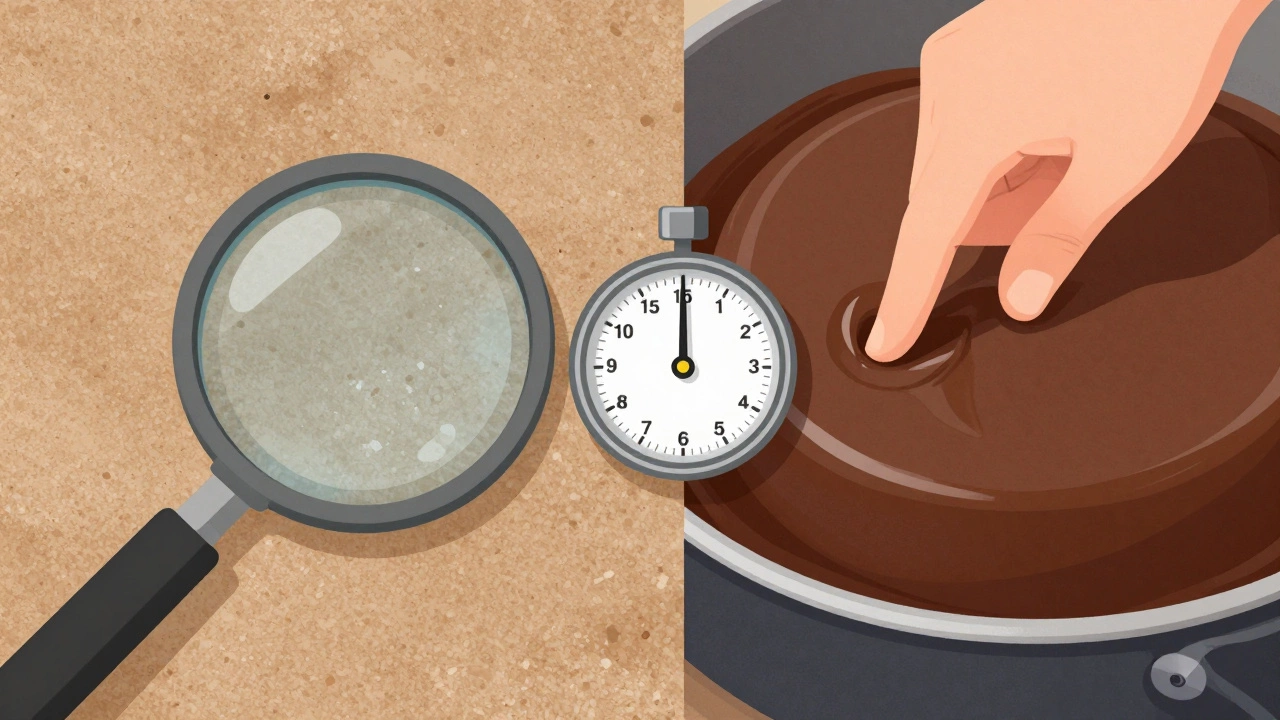
How to Fix It (If You Already Stirred Too Early)
You can’t undo it, but you can rescue it. If you realize you stirred too soon and the fudge is grainy, don’t throw it out. Pour it back into a saucepan. Add 1/4 cup of heavy cream or water. Heat it gently over low heat, stirring just enough to dissolve the crystals. Bring it back up to 112°C, then let it cool again-without stirring-to 49°C. Then stir as directed.This works because you’re resetting the sugar solution. The added liquid re-dissolves the big crystals, and you get a fresh chance to form the right tiny ones. It’s not perfect, but it’s way better than wasting a whole batch.
The Right Way to Make Fudge (Step-by-Step)
Follow this sequence, and you’ll get smooth fudge every time:- Combine sugar, butter, milk, and chocolate in a heavy-bottomed saucepan.
- Cook over medium heat, stirring until the sugar dissolves. No more after that.
- Bring to a boil. Do not stir. Let it boil until it hits 112°C on a candy thermometer.
- Remove from heat immediately. Do not stir. Let it cool to 49°C (about 15-20 minutes). You can speed this up by placing the pan in a sink of cold water-but don’t stir.
- Once cooled, stir in vanilla and any add-ins (nuts, sea salt, etc.).
- Pour into a greased pan. Let set at room temperature for 2-3 hours.
That’s it. No rushing. No stirring. No guessing. Just patience.
Common Fudge Mistakes (Besides Stirring Too Early)
Even if you wait, other things can go wrong:- Using a thin pan - It heats unevenly. Use heavy-bottomed stainless steel or copper.
- Not using a candy thermometer - Guessing temperatures is how most fudge fails. A $12 thermometer is worth it.
- Stirring after pouring - Once you pour it into the pan, leave it alone. Moving it causes air pockets and uneven setting.
- Adding ingredients too soon - Chocolate and vanilla should go in after cooling. Add them while the mixture is still warm, and they’ll seize or separate.
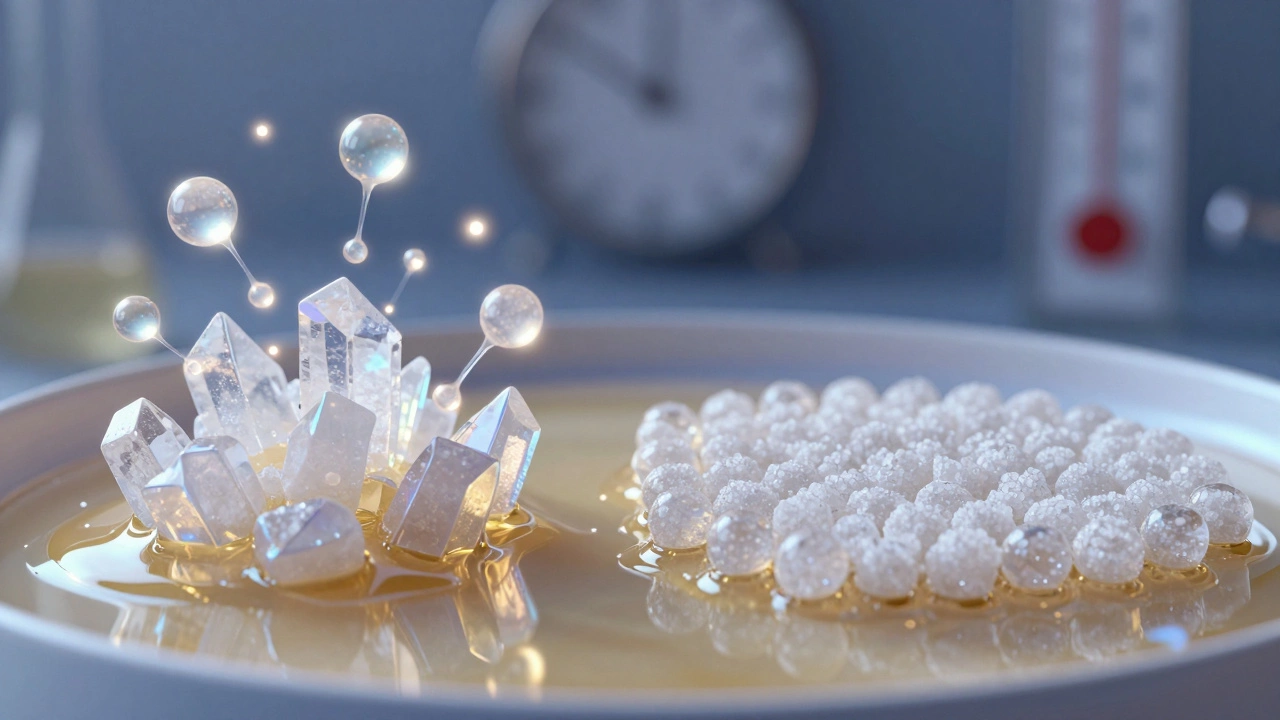
Why This Matters Beyond Fudge
The same principle applies to other sugar-based candies: caramel, toffee, marshmallows. If you stir while hot, you risk ruining the texture. Fudge just makes it obvious because the difference between smooth and grainy is so stark.Think of it like making whipped cream. If you overbeat it, it turns to butter. If you stir fudge too early, it turns to sugar grit. Both are the result of forcing a physical change too soon.
Pro Tip: Use a Timer
Set a timer for 15 minutes after you take the fudge off the heat. Don’t check it. Don’t peek. Don’t stir. Just walk away. The cooling process is silent, but it’s doing the most important work. When the timer goes off, give it a gentle stir. That’s when the magic happens.Final Thought: Patience Is the Secret Ingredient
You don’t need fancy tools or rare ingredients to make perfect fudge. You just need to wait. The science is simple. The discipline? That’s harder. But every time you resist the urge to stir too soon, you’re one step closer to fudge that melts like butter and tastes like heaven.Why does fudge become grainy if stirred too early?
Fudge becomes grainy because stirring while the mixture is still hot causes sugar molecules to form large, uneven crystals instead of tiny, smooth ones. The heat keeps sugar dissolved, and agitation triggers premature crystallization. The result is a sandy texture instead of the silky, melt-in-your-mouth finish you want.
What temperature should fudge reach before you stop cooking it?
Fudge should be cooked to 112°C (234°F), known as the soft-ball stage. This ensures the sugar syrup has the right concentration of water and sugar to form smooth crystals when cooled. Use a candy thermometer for accuracy-guessing leads to failure.
Can you fix fudge that’s already grainy?
Yes. Pour the grainy fudge back into a saucepan, add 1/4 cup of heavy cream or water, and gently reheat until it melts and reaches 112°C again. Let it cool without stirring to 49°C, then stir in flavorings. This resets the sugar solution and gives you a second chance at smooth texture.
Is a candy thermometer necessary for fudge?
Yes, especially for beginners. Fudge is unforgiving. The difference between 110°C and 115°C can mean the difference between perfect texture and a hard, crumbly mess. A candy thermometer is cheap, reliable, and eliminates guesswork.
How long should you let fudge cool before stirring?
Let it cool to 49°C (120°F), which usually takes 15 to 20 minutes. You can speed this up by placing the pan in a sink of cold water, but never stir during this time. Once it reaches that temperature, stir gently to encourage even crystallization.